Tuesday, August 7, 2018

Tuesday at DJHS

This post is by Rich


It's Tuesday,  August 7, at 9:53pm in the YMCA Guest House in Mumbai. Today was our second and final day of teaching at the Diamond Jubilee High School. Tomorrow we will go to the Diamond Jubilee Girl's School, located a little distance away. It's a school expressly to educate the Muslim girls in its neighborhood, and one of my favorite schools in the world. They do great work there. I look forward to it. I am scheduled to teach a 9th grade class in the morning, and a 1st-grade class in the afternoon. After school, we will return to DJHS to host their first-ever Family Literacy Night. There are over 60 signed up to attend so far! It should be fun.

On Thursday, there is a protest scheduled by a political group. Due to fears of disruption and possible violence, the student workshop scheduled for that date has been postponed to Saturday. DJHS plans to have school that day, but we plan to take the day off to remain at the Guest House to recuperate, rest, write, and prepare for the Teacher Workshop, which is still on, for Friday August 3rd. There is an outside chance that there will be a curfew imposed on Friday which might impact the Teacher Workshop. I really really hope not.

Our colleague Brendan leaves us after tomorrow - he must return to Boston to attend to his regular life. Mohsin still has nor secured a visa to come to India. I really hope he is able to get here for the Teacher Workshop. That's exactly how it worked out three years ago. Perhaps we will see a redux.

Today we were all busy at DJHS. I taught six classes, going pretty much straight through fro, 8:15am-2pm, with a 30-minute break for tea. My day opened with Class 6-D, working the Mehnaaz, on a mystery story called "The Broken Ear Goes Missing." I helped with some pre-reading and critical reading strategies, and in helping her plan a lesson. Next, I worked in Grade 8-D with Parishma, where I taught a narrative writing lesson. This lesson was videotaped for demonstration later. I went over the Bread Loaf Rules for Writing, and discussed the importance of storytelling. Parishma then offered four topics for students to choose from: Rain, Food, Sport, Holiday Destinations. We invited the students to write a story about one of those topics. then had a sharing session. The students were very involved in their writing and in the sharing session. One boy wrote about food, and his father, who is a single father raising his kids. The boy teared up halfway through the story, but was able to finish.

Next,  I worked with Saira and Class 10-B on an environmental issues advocacy piece. The students created posters that advocated for solutions to environmental issues. They were all great. One in particular about water included a raindrop with a human face - and the human face has a tear running down its cheek. Water is crying.


My fourth class of the day was with Fatima in Class 6-B, where they worked on message writing. The students all use What's App to communicate with fiends, parents, etc. We invited them to write a What's App message to their friend, and then to re-write it to their parents, and re-write it to their teacher or coach. I explained the idea of code-switching, and how we use different grammatical structures and vocabulary depending on audience.

After a tea break, I joined Mubaraka for Grade 6-A Geography. They are starting a unit on Water Bodies (lakes, rivers, etc.)  We used a K-W-L chart, first asking students to write and share what they know about water, then showed 2 videos about water and water pollution, and asked students to add to their KWL chart. To synthesize, I then led a dance exercise. We were in the music room, so we had a big, open space, ideal for movement. I put the students in three groups. One group represented the Ocean, one represented a River, one represented a Lake. I taught physical motions to each, to demonstrate what healthy Oceans, Rivers, and Lakes look like. Oceans wave and move back and forth; Rivers flow; Lakes ripple. We got all three groups going at once in a collective, 35-student dance to demonstrate healthy water bodies. Then I asked them to freeze, then meet as groups and determine how to change the dance to represent a polluted, unhealthy water body. After a brief planning process, they resumed the dance, and the moves they came up with were very cool. Because the unhealthy dance was too sad, I asked them to end with a re-play of the healthy dance.

My final class of the day was Class 6-C Geography with Mehnaaz, and we did the same lesson we did with Class 6-A, about water bodies. This class met in a a traditional classroom, but we didn't let that bother us - we did the dance anyway. We gave them more time to plan than the other class, and these students produced a really interesting dance to show unhealthy water bodies. The lake group, for example, began rippling as usual, but then several came by to throw trash into the lake, and the dances slowly shut down their dance, demonstrating how pollution can kill a lake.

The teaching day ended at 2pm, and then we had lunch and a de-briefing session with the cooperating teachers in the Teacher Resource Center. Overall in 2 days I worked with 9 teachers to teach 12 classes in 3 subject areas (English, Geography, Chemistry). Our group of 5 (me, Julia, Alan, Brendan, Ingrid) worked with 22 teachers in 26 classrooms from grade 3-10, teaching more than 50 lessons, reaching over 800 students, providing more than 50 hours of job-embedded professional development.

After the de-brief, we headed downtown, to a shopping area. Ingrid, Brendan and I browsed markets, where we bought clothes, scarves, and art. Crossing the street in Mumbai traffic is always an adventure:


We walked to the Gates of India, which were built to "welcome" King George V to his Indian colony in 1911. In 1948, when the British army left India at the time of its independence, they left through these gates, and no one has gone through them since. I wore my Andover Wrestling hat to represent.


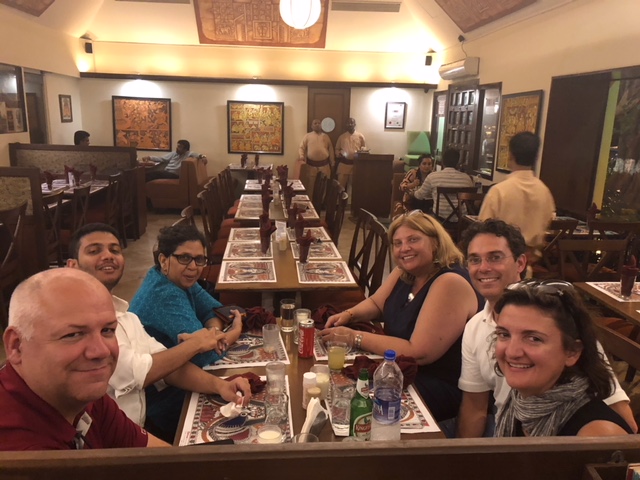
We concluded the evening with dinner at a nice restaurant downtown, hosted by Lee. We were joined by Lee's son Duyshant, who I have known since he was 11. He is a grown man now, a lawyer who works not far from this neighborhood, and he is to be married this December. He and Lee have a wonderful give-and-take that shows both their deep love for each other, and their quick-witted intelligence. It was  joy to spend time with them.

Thanks for reading,
Rich


Our Second Photowalk in Karachi

With our first Photowalk behind us, we geared up for another exploration in the hot Karachi sun, punctuated by incredible sights, sounds and smells.

We visited Mohatta Palace, originally the residence of a family ftom the Maheshwari community. After the Mohattas left Karachi in 1947 (proceeding the Great Partition that created the Muslim state of Pakistan and the Hindu-dominated state of India), it passed into government hands. It was given to Fatima Jinnah, the sister of Pakistan's founder, Quaid-e-Azam Muhammad Ali Jinnah. It is now a museum and had a startling archeological exhibit of a late 13th-14th c. necropolis.


We then spent some time at Sea View, a picturesque part of Clifton Beach, right on the Arabian Sea. As soon as we got off the bus, the dune buggy and camel renters stampeded towards us. It was a good move, as quite a few of us took rides.


Even I got into the action, much to the amusement of the entire beach and the consternation of the 
camel. My understanding is that all future showings of the classic David Lean movie will be referred to as "Alan of New Jersey". T. E. Lawrence may have known about the "Seven Pillars of Wisdom", but I certainly have intimate knowledge of "The Three Ways of Camel Burns"


Despite the incredible amount of attention at my riding skills (none), the highlight of the day was the Empress Market. Built in the time of and named after Queen Victoria - the "Empress of India" - it is now a cramped, crowded series of market stalls with everything from tea and pickle vendors, to pet sellers to a large section devoted to an open-air butcher. The smell went, respectively, from the divine to the abhorrent. I could take it, but many of the Pakistani teachers and students had to find the nearest exit after a few minutes. I'll spare us all those photos, though I admit it was absolutely fascinating.


pickle vendor keeping the flies off the product


This last one turned out to be my favorite picture of the day. As I was walking towards the exit, there were vendors of many dry goods. As with most people in Karachi, a smile and greeting in Urdu unlocks smiles in return and requests for pictures being taken of them.

The people of Karachi are kind, and intelligent, and warm. Just look at these two.


Thanks for reading!


Monday, August 6, 2018

Monday at DJHS

This post is by Rich

A frenetic, packed day one at Diamond Jubilee High School in Mumbai on Monday, August 6th. Alan, Julia, Ingrid, Brendan and I taught straight through from 8:20-2:00 with a 30-minute break, then had a debriefing session with the teachers before returning to the YMCA Guest House, where I sit to write this entry, at 6:43pm local time.

My day was terrific. I opened with Parishma in Class 7-A. In this school, the students do not move between periods - the teachers do. There are 30-35 students per class, and 3-4 sections per grade (7-A, 7-B, etc.) Teachers move from class to class depending on their specialty. Students wear uniforms: khaki pants for boys, skirts for girls, button down uniform shirts, and neckties. Every student is in uniform. Parishma and I co-taught from 8:20-9:30, a creative writing lesson. We reviewed the Bread Loaf rules, then I asked students to make a list of they favorite places in Mumbai, choose one, then write a 5-senses poem about that place. (I went to... I saw..., I heard..., ending with "I felt"). The class ended with a sharing session in which students read their individual pieces. Next I went to 7-C, for a 35-minute lesson with Mehnaz, looking at a Roald Dahl poem called Television. Most of the class was a discussion about the positive and negative effects of television and other technology. Next was an elective period, a 35-minute session with Grade 10 students, taught by Grace. The students were writing advocacy pieces about sustainable practices to solve environmental problems. I gave a quick, impromtu lecture on the Rhetorical Triangle and appeals to Pathos, Ethos, and Logos, then we asked the students to begin constructing arguments. I was amazed at how well they incorporated the agreement strategies in pieces written so quickly. Next was a Grade 8 class with Krishnaveni, a terrific, veteran teacher whom I worked with in the past. I got there late, and the class was doing dramatic readings from the play The Mousetrap. Krishnavni asked me to coach a group on their reading, and video recorded me as I did it, to show other classes.

From 11:15-11:40, we had a tea break, then it was back to class. From 11:40-12:50 I worked with Shabnam in Class 6-A, on a creative writing lesson. We split the class into groups and used the Story Circle model that we've learned from New Orleans folks:


After the Story Circles, students wrote, then shared. The process went really well.

My final class of the day, from 12:50-2:00, was with Glenn, a first-year chemistry teacher, in Class 6-A. The lesson was an experiment, designed to help student synthesize what they have learned about chemical elements so far in the class. First, I led students through writing an 8-line "I am" poem (I am [name], I am wonderful because, I am useful because, I am dangerous because, I want to interact with, I do not want to hang out with, I want to, I am [name]).  After students wrote those poems, and five shared, I then explained how we were going to convert it into a Chemistry lesson. Glenn put the students in pairs and assigned each pair one chemical element - Hydrogen, Oxygen, Flourine, etc. We then asked the students to write an "I am" poem from the perspective of that chemical element. When students has questions about the elements, we referred them back to their textbooks. After they had time to write those poems, we invited them to share:


My favorite was, "I am silicon"


It reads:
"I am silicon (Si).
I am  wonderful because I am metalloid
I am useful because I am used in semi-conductors and computer chips
I am dangerous because I cause damage to the skin
I want to interact with silver, gold and oxygen
I do not get along with chlorine, sulphur and sodium
I want to be the most used chemical in the world
I am silicon (Si)."

 The lesson worked well.

From 2:00-2:45 all of us and our cooperating teachers met in the Teacher Resource Center and debriefed the day. Also today, Ingrid did art projects with various grades, Julia did drama and close reading workshops, Alan did a variety of music workshops (including re-working Dolly Parton's classic song '9-to-5' in a class on Commerce), and Brendan taught writing workshops to grades 3 and 5.

The student workshop has been officially rescheduled to Saturday, out of concern about the possible strike and protests. We do not believe they will impact the area where we are staying, but students attending the workshop will be traveling from other parts of the city, and so the event was rescheduled to ensure their safety.

And so we will return to DJHS tomorrow (Tuesday), and go to the Girl's School on Wednesday as planned. The teacher workshop (75 teachers from 17 schools) is Friday, and the student workshop (102 signed up!) is Saturday. It should be a good week.

Thanks for reading,
Rich


Sunday, August 5, 2018

Mumbai Planning Meeting


This post is by Rich


Greetings from Mumbai, Maharashtra, India. It's 8:53pm local time and I've just returned from going out to dinner at a very nice Asian Fusion restaurant in the Phoenix Mall called Pa Pa Ya, about a 15-minute cab ride from the YMCA International Guest House, where we are staying. The Guest House is a terrific. It's a hotel, really, with nice rooms and a good restaurant. It's not fancy but it fits our needs perfectly. I stayed here back in 2015 when we were here for the first ABL Mumbai Conference.  Now we're back, for the South Asia Peace Literacy Conference. In Karachi we called in Arts Without Boundaries, because publicly labeling it a Peace Conference might have attracted unwanted attention.  However, it's really all part of the Andover Bread Loaf International Peace Literacy Network. Our goal is to create a more peaceful world, using the power of literacy, in all its forms, to build communicates and connect teachers and students across boundaries, and to critically examine what it means to internationally communicate across difference. And so, we're now in Mumbai.

Today was our planning session, at the Diamond Jubilee School:


Our host is Lee Krishnan, who attended the ABL Teacher Workshop alongside Mohsin Tejani from Karachi, me, Mary Guerrero, and others, back in 1997. The four of us have worked closely every since, in the US, India, and in Karachi. This is my third trip to Mumbai. I came in 2007, along with my sister, Eileen, and spent a week teaching with Lee. In 2015, Lee and her school hosted an ABL conference, and it was such at hit that by the end of the event the school principal, Nutan Iyer, was asking when we would return. Well, 2018 is the answer. Yesterday, August 4th, Brendan, Julia, Alan and I flew in from Karachi, and are joined by Ingrid Hess, a U-Mass Lowell professor, artist, and children's book author.

The flight from Karachi to Mumbai used to take a little under two hours, flying direct. However, the animosity between the two governments is so strong now that you literally can not fly direct. Instead, I flew from Karachi to Dubai, in the United Arab Emirates - a two hour flight across the Arabian Sea. After a three-hour layover, I flew from Dubai to Mumbai - two hours and forty-five minutes. In all, it took eight hours to travel what should take two. It's absurd. It's like flying from Boston to New York but having to go through Houston because Boston and New York don't get along.

But we made it. Mohsin his colleague Basil Andrews are still back in Mumbai, dealing with visa issues. An American can get a visa to go to India in one day, on line. For a Pakistani, it takes two months, invitation letters, etc.  It's complicated. We are hopeful that Mohsin and Basil will be able to join us.

Our host institution is the Diamond Jubilee High School (DJHS), which is part of the Aga Khan Education Services (AKES). We've partnered with AKES since the mid-1990s, and they have connected ABL with a long list of wonderful teachers and schools. AKES schools are intended to serve the Ismeli Muslim community in some of the poorest areas in the world. DJHS serves students in Grade 1-10, and you don't have to be Muslim to go to school there, or to work there. It's a terrific place that I have come to know well. We will also work with the Diamond Jubilee Girl's School, located a short distance away, that serves exclusively Muslim girls, in a neighborhood where girls do not always go to school. I remember that place well from my last visit - it was truly inspirational.

Brendan, Alan and I all participated in the 2015 conference and today it was great to see and reconnect with many friendly faces, including the principal, Nutan Iyer, and teachers, including Shabnum, Jamila, Fatima, Arjuman, Taskin, and more. They remembered us well and even reminded us of workshops we did back then that I couldn't remember! Apparently some of the students remember us as well, and are excited about out visit, and working with us further. We are excited as well.

This week, we will spend Monday and Tuesday team-teaching with DJHS teachers at Diamond Jubilee, then Wednesday we will team-teach at the Girl's School. On Wednesday evening we will host a family literacy night at DJHS. On Thursday we will run a one-day student workshop for about 100 kids, hosted at DJHS. On Friday we will run a one-day teacher workshop, also at DJHS. There are 75 teachers from 17 different schools signed up. It will be a full and busy and rewarding week.

One possible kink in the plan is that a political group might stage a protest - that has nothing to do with us, mind you - on Thursday. They did protest last Wednesday, demanding higher wages and more jobs for their community, and some schools shut down out of fear of violence. It is rumored that the group will protest again this Thursday, and if that rumor is confirmed, we might cancel the student workshop on that day, possibly rescheduling it for Saturday.

But the planning must begin. Today (Sunday) we gathered at DJHS to meet with and co-plan with our  co-teachers. ABL International has evolved a model of co-teaching, so we intentionally work side by side with local teachers. We've been in touch on-line over the last several weeks, but nothing beats meeting in person.


Alan, Julia, Brendan and I are each paired with several DJHS teachers to plan and execute lessons. My schedule is typical of us four: on Monday I co-teach a 7th grade creative writing class with Parishma at 8:20am, a 7th-grade English class with Mehnaaz at 9:30, a 10th-grade writing class with Grace at 10:05, an 8th-grade class with Krishna at 10:40, a 6th-grade creative writing class with Shabnam at 11:40, and a 6th-grade chemistry (!) class with Glenn at 12:50. On Tuesday I teach a 6th-grade English class with Mehnaaz at 8:20, an 8th-grade narrative writing class with Parishma at 9:30, a 10th-grade Commerce Studies class with Saira at 10:05, a 6th-grade writing class with Fatima at 10:40, a 6th-grade geography class with Mubaraka at 11:40 and a different 6th-grade geography class with Mehnaaz at 12:50. On Wednesday, I will co-teach an English class and a creative writing class to 8th graders in the morning, and two classes with 1st graders in the afternoon. Lee made up our schedules, and she does not mess around.


Brendan was not on the same flights from Karachi to Dubai as I was - he flew late in the day on Saturday, while I left in the morning. This gave him the time to visit the Dream Foundation Model School in Karachi. This school serves some of the poorer students in the city. It charges no fees. They sent us about half of the participants in our Karachi workshop, and also a wonderful, wonderful teacher, Junaid Ahmed, who helped bring the kids and worked with us all week. He is really something special. Brendan told wonderful stories about his visit. The school trains 9th and 10th graders to work as assistant teachers in the younger classrooms, and intentionally develops students as leaders. Brendan was especially impressed with Aziz, a student who participated in our workshop and whom I consider the coolest man in the universe. He is an assistant teacher with younger students and is magical with them. I am jealous that Brendan had the chance to spend time there.


Here is the kicker - the Dream School is funded in part by Madonna, the pop singer from Michigan. Crazy world we live in.

Thanks for reading,
Rich


Friday, August 3, 2018

Final Exhibition

Posted by Rich


It's 9:07pm on Friday, August 3rd, our final night in Karachi. This evening was the final exhibition of the Arts Without Boundaries program co-sponsored by The School of Writing and Andover Bread Loaf. We held the final exhibit at The Second Floor (T2F), a community arts space in the DHA area of Karachi, just a few blocks from The School of Writing offices. It was an outstanding event, with great joy for us all. Visitors  said they had never seen anything like it before. Rahedeen Ali, director of the Writing Center at Habib, said she was moved to tears. A parent said, "my daughter has been coming home each day and telling me how great her day was. She said this has been the most incredible week of her life." Another visitor said, "We don't have anything like this in Pakistan. You gave these kids a voice."

We gathered at The School of Writing offices at 10am to begin final preparations. Brendan, Alan, Julia and I each met with our small group of ~6 students to work on their writing for the exhibition. Each student selected one piece to perform at the exhibition, and we coached them on delivery. In my group, 3 of the 6 students chose pieces they had written in Urdu. I was not able to coach them on content, but I did coach them on delivery (reading clearly and slowly and loudly with emphasis and rhythm.) Surprisingly, I found it easier to coach the Urdu speakers, because I could really focus on delivery. After that session, Julia and Alan led the students through rehearsals and final tweaks of the music and theater performances. We had lunch, then walked over to T2F. 


On the first floor, T2F has a large open space with brick walls and a hardwood floor. One wall is lined with books and art for sale. This was our performance space. On the second floor there is a cafe. We set up the space, hung 75 photographs (that were printed and framed overnight in a spectacular effort by a special crew) around the space, and rehearsed the performances. At 4pm, the big show began. Including participants, we had an audience of perhaps 50 folks, including some parents, visitors from the university and from the Pakistani-American Cultural Center, and other fans of TSW.

Jinaid, the terrific young teacher from the Dream Model School, served as Master of Ceremonies. He first introduced Mohsin, who spoke in Urdu and gave the audience and overview of the week and how it came about, including the story of how Lee Krishnan, Mohsin and I came up with the idea for this conference while riding on a bus to Vermont in July of 2017.


The photographs are really something. In two days touring the city, the kids really captured the look and feel of the places, people, sights, sounds, movement, tastes, smells. Once the space was filled with images, ringing all around, the space felt really special. And these were the 75 that the students chose out of perhaps 1,000 photos they took.

The first performance was music. Alan's music group performed their original composition, "Imagine Karachi", using song and drums. It was full of those pauses that make music - the space between the notes. A person I was sitting next to said she was surprised that they composed the song in only four days. I pointed out that it had been more like three hours.


 After that performance, the first 13 participants read their individual pieces. Jinaid called each reader up to the microphone in random order. Some read in English, some in Urdu.


At the halfway mark, the theater group performed the first of their two pieces, "Empress Market." A dozen students re-created the feel, sounds, and sights of one of Karachi's oldest marketplaces, complete with our colleague Brendan McGrath as a beggar.


Julia and Amtul did extraordinary work with that group, capturing the student voice in the piece. After that, the other 13 participants read their individual work. Finally, the theater group performed their second piece, about the Hindu Temple we visited, honoring the rituals they had observed. At the end, Hasnein thanked the organizers of the week, the participants, and the audience. Many folks tried to single out us four Americans, but we pushed back. This week was about Karachi, not about us. When we took the group photo, some wanted me to sit in front, but I refused. The TSW staff sat in front, ringed by the students. I was in the back, as well I should be.

When the event ended, we spent some time chatting and hugging and taking selfies and smiling and enjoying each other. The students did not want to leave. One told me he didn't want the feeling to end. Adult visitors were clearly moved. Several spoke about how there isn't a venue or tradition for student voice in Karachi, and spoke of the importance of providing it. For me, it was very cool to see four art forms - writing, photograph, music, and drama - combine to tell the story of Karachi.

On a side note: I began to realize today that for many of the students, visiting the Hindu temple was a really big deal. This is a country that is 96% Muslim, but that has a significant Hindu population. Many students testified that they began to understand the importance and richness of religious diversity.

During the day, I got to speak with some of the T2F staff, including Babool Aqeel, the communications manager, and Arieb Azhar, the executive director. T2F is an initiative of PeaceNiche, the non-profit started by Sabeen Mahmud, who was assassinated in 2015. PeaceNiche supports a number of initiatives for peace, including T2F. I discussed with them the local cafe and bookstore in Lawrence, El Taller, which has a similar mission to T2F, and even a strikingly similar physical space!


After our event ended about 6pm, we stuck around at T2F for a while as their weekly Open Mic event took place, and had dinner in the cafe. The Open Mic was pleasantly surprising to me. About 75 young adults, mostly 17-25 or so, crowded into the space, and signed up to read poetry, play music, do comedy, and enjoy each other's company, in a safe space. I signed up and read my "Goodbye to Karachi" piece, and Alan performed his song "Avalance" on his makeshift Taiko drums (a drum top on a plastic bucket).

Check out lots more photos and video from the event on The School of Writing Facebook Page, thanks to Annie Tejani, including a video of me reading Goodbye to Karachi.

More hugs, more selfies, and we headed back to the Guest House. Alan and Julia fly out at 7am, I fly at noon, and Brendan at 7pm. We are all heading for Mumbai, where we will spend a week working with Lee Krishnan and her folks at the Diamond Jubilee School. We are exhausted, but energized. I am jealous of Brendan, who has time tomorrow to visit the Dream School as the guest of Jinaid before he flies later in the day.

All week, the lingering question has been Mohsin's visa to India. A core dream of this conference was the hope that we could bring Indian teachers to Pakistan, and Pakistani teachers to India. So far, we've been unable to do so, due to visa issues. The animosity between the two governments is severe. Mohsin applied for his visa two months ago, and despite pressures from every direction we could think of, it has to come through yet. We had hoped for four other folks - one was denied, and two others languish in the process. We remain hopeful we can get Mohsin to Mumbai next week, but it's no guarantee.

I leave at 8:30am for the airport. My next post will likely be from either the Dubai airport en route, or from Mumbai once I arrive.

Thanks for reading,
Rich


Thursday, August 2, 2018

Habib University

This post is by Rich

It's 9:50pm on Thursday August 2nd and we've just returned from an evening visit to Habib University which was really, really cool. It's been a long day, as every day has been long, but I didn't want to miss Habib, a place I've heard so much about.

Habib University was founded in 2012, with Mohsin's friend Wasif Rizvi as president. It's the first expressly liberal arts university in Pakistan, a country with perhaps 1,000 colleges and universities. Most of the colleges and universities provide technical or business training. While Habib does offer majors in computer science and electrical engineering, as well as social policy and other liberal arts fields, every student must study a liberal arts core. The school was started by the Habib family, a major banking family in Pakistan. We drove there after session today, met with several administrators, went on a tour of the facility, and had dinner. It was very, very impressive - a brand-new space with the latest in design computers, film studio, library, swimming pool, tennis court, etc. The school's motto is "Every human being's worth is in their Yoshin." The word "Yoshin" is an Arabic word meaning "thoughtful self-cultivation." Their five core values are beauty, respect, excellence, passion, and service. The architecture really struck me. It is not like any other university I've been to. It does not try to be Oxford or Yale - it's designed appropriate for its space, and I think defines a new Pakistani architecture. Lots of open air spaces, wide hallways, plenty of meeting spaces, large indoor and outdoor auditoriums. The school currently has 650 students and is growing fast - expanding to close to 900 in two weeks, and more after that. This spring they graduated their first-ever class, and Mohsin's son Ali was one of the graduates. All of the members of his inaugural class as considered co-founders.


 I spent time chatting with Rahdeen Ali (wearing yellow in the picture above), who is the manager of the Writing Center. It's one of the first Writing Centers at any university in Pakistan. Mohsin was helpful its its creation. Rahdeen and I discussed writing centers and ideas for promoting and improving her work. I also chatted with Yasmin Bano, an administrator of Habib, about expanding the community service program. These people are very smart, very serious, and committed to the goal of making Habib one of the world's top 100 universities by 2030. I wouldn't be against them. I promised to do some workshops at Habib when I return to Karachi.


I was thrilled to unite with Yasmin Bano, who I met at the 2002 ABL conference at the Mzizima Primary School in Dar-es-Salaam, Tanzania, and with R____, who I met at the 2000 ABL Millennium Conference here in Karachi. It was great to be together with them and with Mohsin, both to remember the conferences, and to realize that here we are, 16-18 years later, still doing the work.

The quote "those that love sausage and respect the law should never watch either of them being made" is traditionally attributed to Mark Twain, and generally means that the process of creation can be messy. Today was the sausage-making day of our student program. We spent the day at The School of Writing offices. The students arrived about 9:30, and all had selected two pieces of writing for the final exhibition, as we had asked. We worked with each student one-on-one to go through the photographs they took on our two field trip days, and asked them to select three for the exhibition. Once that process was complete, we assembled together in the main space for a series of warm-up exercises led by Julia and Alan, then divided up into two groups, each with about 12 students. Julia and Amtul took one group for the next three hours, while Alan had the other group. After messy sausage-making (metaphorically), each group emerged with a fantastic performance. Julia and Amtul's group created two scenes, one of Empress Market, and the other of the Shri Laxmi Narayan Temple, each including movement, words, and sounds. Alan's group used drums, words, sounds, rhythm, and melody to write and perform an original song, "Imagine Karachi."  At 3:30 the groups came back together and performed for each other, and made minor tweaks. What the kids did, and the facilitators facilitated, in three hours, was impressive to watch. It was very-good sausage making.

As I've discussed with all the facilitators, this week is an experiment. We won't know how to do it until we do it. It's a beautiful, magical, rare opportunity, to have a group of master teachers together with 25 students and a full week to work with them. It's an experiment in what's possible in teaching and learning. It's an experiment in communicating across difference. It's a learning experience for all of us. And it looks like it's going to end with some darn good sausage.


On Friday we will meet again at 10am, to work the performances and practice for the final reading. After lunch we will walk over to T2F ("The Second Floor"), a community arts space, to prepare for the final exhibition, which is scheduled for 3-6pm. In addition to the theater and music performances, the students' photography (some 75 images) will be on display, and each student will read a piece of their writing. It should be pretty cool.

At the end of today's session we held a quick debrief, then gave each participant a Post-It note and asked them to write a few thoughts. Here are some:

"I enjoying a lot last four days we make so much."
"Last days we make so much fun with Sir Alan"
"We built knowledge and learned a lot. Keep it up!"
"In these four days I got to see my city in a new way."
"The whole training was just amazing which was a blend of writing, photography, acting, and singing. Really thank Brendan, Julia, Alan, Rich, Sir Mohsin, the Andover Breadloaf & The School of Writing for this opportunity."
"Overall session was learningful and enjoyable. All the teachers were loving and great."
"This past week was a lifetime experience for me, got a chance to meet new people, saw many new faces and got a chance to work with them really boosted my teamwork skills and confidence."

I look forward to the final exhibition at T2F tomorrow, I do not look forward to leaving Karachi on Saturday morning, and I *do* look forward to seeing old friends and making new ones in Mumbai starting Sunday, and our work there next week.

Thanks for reading,
Rich


Wednesday, August 1, 2018

Our First Photowalk


On Tuesday, we had our first of two Photowalks. The School of Writing has created an incredible program in which students and teachers are taught the basics of digital photography and then taken out to culturally important parts of Karachi. They include destinations of state, social and religious significance.

Already familiar with taking photos on their phones, Basil Andrews, a marvelously talented photojournalist, did a workshop with the participant on Monday regarding the technique and emotion of a great photo.

Our first stop was Old Karachi, a bustling street with buildings, some of them just abandoned facades left standing, built back in the mid-late 19th c.


Then we went to Shri Laxmi Narayan Mandir, a Hindu shrine, right alongside a port. There was a funeral ritual in progress, with the ashes being prepared for final dispersal into the water (note: we were told repeatedly that it was alright to take a picture, something we pushed back on intensely, until finally giving in, with as much reverence as we could manage in this kind of situation).


Outside the temple shrine was a transgender beggar who was making bread to sell. It is not unusual to see transgender people, and they will undoubtedly be beggars. From my discussion with Pakistanis, they are considered an inferior class of people who will not get any sense of belonging or normalcy in this society. I note that this is obviously the norm when it comes to transgender lives all over the world and do not share these thoughts with a wagging finger. In other words, we all gotta get our sh*t together when it comes to rights for all people.


We ended our day at Frere Hall, a remnant of the Raj, or British rule, which ended with the independence of India. This, of course, leading to the great Partition that started in 1947, and whose effects are still felt to this day.

Frere Hall was a performance venue of the late 19th c. built by the British to entertain their community. It is now a cultural landmark that contains an exhibition space for contemporary artists.


The other half of students went on a different Photowalk today, and we will be switching destinations tomorrow. Today was magnificent and I can hardly wait to see what tomorrow brings.